Love to start your day with a live blog? Then we’ve got some good news. We’re live blogging this morning beginning at 9:30 a.m. EDT as we await one or more opinions in argued cases.
At the Court
After the possible announcement of opinions this morning, the justices will meet in a private conference to discuss cases and vote on petitions for review. Orders from today’s conference are expected on Tuesday at 9:30 a.m. EDT.
The court has not yet indicated when it will next release opinions.
Morning Reads
Trump Court Picks Now Cite Justice Jackson on 2020 Election
Olivia Alafriz, Bloomberg Law
When asked by Senate Democrats about “the outcome of the 2020 election,” some of President Donald Trump’s judicial nominees are turning to a potentially surprising source as inspiration for their answers: Justice Ketanji Brown Jackson. Recent nominees have cited Jackson’s statement that it “wasn’t proper for her to comment on political matters” when she was asked about the 2020 election results during her 2022 confirmation vetting to explain why they, too, are declining to address the outcome of the 2020 election, according to Bloomberg Law. “I think the answer that Justice Jackson gave is the only legally and ethically correct one,” said Matthew Schwartz, whom Trump nominated to the U.S. Court of Appeals for the 2nd Circuit, during his confirmation hearing on Wednesday.
Costco urges US judge to reject consumer class action over tariff refunds
Mike Scarcella, Reuters (paywalled)
In a Monday filing, Costco “asked a federal judge to dismiss a proposed class action claiming the retail giant owes customers refunds for higher prices it charged before the U.S. Supreme Court struck down import tariffs imposed by President Donald Trump,” according to Reuters. The company “called the lawsuit speculative and said the customer who lodged the case suffered no harm.” Costco noted that “it has not yet received any refunds and it is unclear when it might do so or in what amount.”
White House must comply with Presidential Records Act, judge rules
Josh Gerstein, Politico (paywalled)
In a Wednesday ruling, U.S. District Judge John Bates “ordered aides to President Donald Trump to continue to observe the requirements of the Presidential Records Act” and preserve documents and other materials related to the president’s official duties, “despite a Justice Department opinion that found the law unconstitutionally intrudes on presidential power,” according to Politico. “Bates concluded that the 1978 statute is likely constitutional and granted a preliminary injunction that essentially nullifies” the DOJ’s opinion. “The original public meaning of the text of the Constitution, canons of interpretation, Supreme Court precedent, general principles of property law, and almost 50 years of practice confirm that Congress has the enumerated power to regulate presidential records,” Bates wrote.
Liberty University student fights for religious studies tuition grant
Liz Lykins, World
The Supreme Court could soon have an opportunity to revisit its 2004 ruling in Locke v. Davey, in which it held that states do not violate the First Amendment when they prevent students seeking devotional degrees from participating in public scholarship programs. Bethany Hall, a Liberty University student who is challenging such scholarship restrictions in Virginia, recently lost before the U.S. Court of Appeals for the 4th Circuit, which cited the 2004 precedent in its ruling against her. Hall told World magazine that she is hopeful that justices will take up her case and overturn the 2004 decision. “It’s just quite simply wrong and very sad that our Supreme Court made that decision back then,” she said. “That’s $20,000 that I just lost because I’m studying what I feel like I should do with my life.”
Trump’s MAGA Supreme Court lawyer breaks tradition, but the justices embrace it
Joan Biskupic, CNN (paywalled)
In multiple high-profile arguments this term, U.S. Solicitor General D. John Sauer has “push[ed] the boundaries of the law at the Supreme Court with a delivery that is quickfire, confrontational and imbued with MAGA attitude,” according to CNN. Although “the justices of even a decade ago” might have been “turned off” by Sauer’s approach, today’s court “has not resisted it.” CNN noted that “Sauer has never faced the pummeling other SGs experienced at the hands of the majority. Liberal justices have occasionally asked him to slow down, and [Chief Justice John] Roberts chastised him during a January argument for interrupting a justice mid-question,” but conservative justices have appeared willing to come to Sauer’s defense when “liberals pounce” on his responses.
On Site
Relist Watch
Daubert dust-up and AEDPA angst
In his Relist Watch column, John Elwood explored two newly relisted cases that will be considered for a second time by the justices today: Union Carbide Corp. v. Sommerville, on when trial judges may admit an expert witness, and Walters v. Coleman, on a grant of habeas relief to an Iraq and Afghanistan veteran who committed several violent attacks.
Contributor Corner
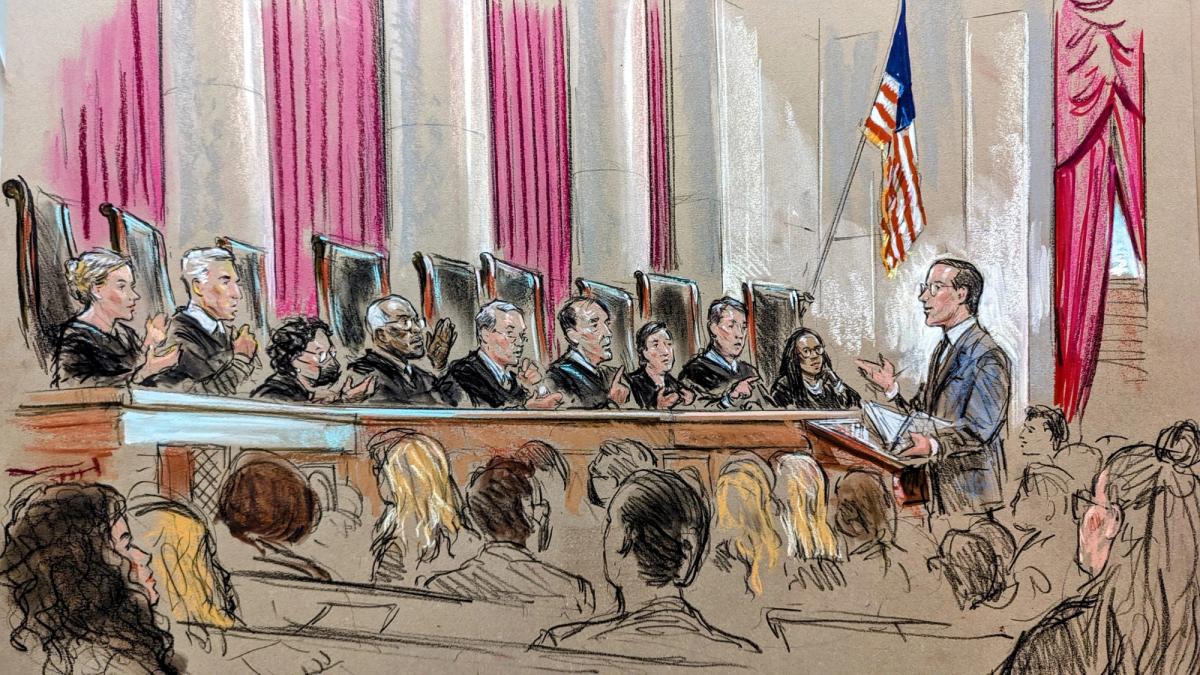
What oral argument reveals about Supreme Court unanimity and division
In his Empirical SCOTUS column, Adam Feldman closely examined six recent Supreme Court cases – three decided unanimously and three decided by contested votes – to answer a (seemingly) straightforward question: Does the nature of the oral arguments appear to differ in ways that predict, or at least are consistent with, the eventual division of the court?
Contributor Corner
In immigration cases, the court doesn’t just settle disagreements
In his Immigration Matters column, César Cuauhtémoc García Hernández reflected on three immigration disputes that the justices chose to hear this term, noting that the cases on birthright citizenship, the Temporary Protected Status program, and the rights of asylum seekers “didn’t arrive before them after lower court disagreement.” By becoming involved anyway, “the court has guaranteed itself a starring role in some of the president’s most prominent policies and in the political storm that swirls around them,” according to Hernández.
Podcasts
Amarica’s Constitution
Scrip for Scripture on the National Mall
After weeks of tracing the background history and constitutional principles at work on religious establishment, free exercise, and equality issues, Akhil Amar and Andy Lipka explore the Trump administration’s support for last weekend’s “Rededicate 250: A National Jubilee of Prayer, Praise & Thanksgiving” event, analyzing how it fits into the constitutional rubrics that were previously examined.
A Closer Look
Dershowitz v. CNN
On Jan. 29, 2020, Alan Dershowitz, a professor emeritus at Harvard Law School who at that time was representing President Donald Trump during his first impeachment trial, appeared on the Senate floor to respond to questions about Trump allegedly pressuring Ukraine to support his reelection campaign. Sen. Ted Cruz, a Republican from Texas, asked Dershowitz to reflect on the legality of quid pro quo agreements. Dershowitz offered a lengthy response, positing, among other things, that “[i]f a President does something which he believes will help him get elected—in the public interest—that cannot be the kind of quid pro quo that results in impeachment.”
Dershowitz’s answer sparked something of a media frenzy as political commentators pushed back against what at least some believed was a “crazypants bonkers” legal argument. CNN dedicated multiple segments to the hearing that day and the next, repeatedly returning to – and repeatedly criticizing – Dershowitz’s remarks. In the following days, Dershowitz attempted to clarify his position, including through appearances on CNN, contending that his comments had been “misinterpreted” or quoted without important context. Ultimately, Dershowitz sued CNN over its coverage, alleging that the network and its anchors and contributors had defamed him by only sharing misleading clips of his statement.
A federal district court in Florida granted summary judgment to CNN, holding that Dershowitz had failed to establish that CNN acted with actual malice – that is, with intentional disregard for the truth. In August 2025, the U.S. Court of Appeals for the 11th Circuit affirmed the district court’s decision, highlighting the Supreme Court’s famous 1964 ruling on defamation: New York Times Co. v. Sullivan.
Under Sullivan, the 11th Circuit explained, public figures like Dershowitz “cannot recover damages for defamation unless they prove that an untrue statement was made ‘with knowledge that it was false or with reckless disregard of whether it was false or not.’” Dershowitz, it continued, had offered no such proof. According to the circuit court, even if “commentators did report incorrectly on Dershowitz’s statements, he has offered no evidence that they did so intentionally. If anything, the evidence shows that they believed in the truth of their reporting, and that they formed their opinions independently.”
In late December, Dershowitz asked the Supreme Court to take up his case and revisit Sullivan’s actual malice standard. Specifically, in his petition for review, he urges the justices to clarify whether “systematic omission of qualifying and limiting language from a plaintiff’s recorded statement constitutes proof of actual malice” and to consider limiting Sullivan’s application and/or modifying its evidentiary standards. As it stands, according to Dershowitz, “Sullivan’s actual-malice standard has devolved into near-absolute immunity for media defendants, even when they profoundly misrepresent verifiable public statements.”
Initially, CNN waived its right to respond to Dershowitz’s petition for review, but, in February, the court called for a response. In that brief, filed last month, the company asserts that Dershowitz has failed to account for the fact that Florida, where he filed his lawsuit, has incorporated the actual malice standard into its state defamation law, meaning that he would still lose under Florida law even if the court revisits and limits Sullivan’s holding. In any event, CNN continues, the court should not change Sullivan because it is “a cornerstone of modern constitutional law” that “was correctly decided in the first place.”
Dershowitz v. Cable News Network is expected to be considered by the justices for the first time during their private conference today.
SCOTUS Quote
“That seems to us to be the common sense of the matter; and common sense often makes good law.”
— Justice William O. Douglas (1957)